Oskar’s school
Let the Right One InOskar’s school is a recurring point in Blackeberg’s everyday geography and a place where distant political danger becomes immediate to children. Its corridors and grounds carry rumors about the Vällingby murderer and the Soviet submarine, while Oskar’s lunchtime conversation with Johan turns the submarine into a way of thinking about nuclear weapons and death.
Setting and Everyday Geography
On his way home after a punishing day, Oskar heads toward downtown Blackeberg despite the risk of encountering Jonny and Micke. The school is the point of departure for that walk, which leads him toward Sabis, the local grocery store. His route registers the ordinary landscape around the school: he takes the zigzagging ramp rather than the stairs, giving himself time to calm down before going in.
The school also anchors a park path between Holbergsgatan and the Chinese restaurant in Blackeberg. At night, the restaurant glows on the hill while the path is dark, its streetlights spaced about thirty meters apart. The school is thus part of a connected neighborhood landscape—paths, shops, and gathering places—rather than an isolated backdrop.
Rumors and the School Grounds
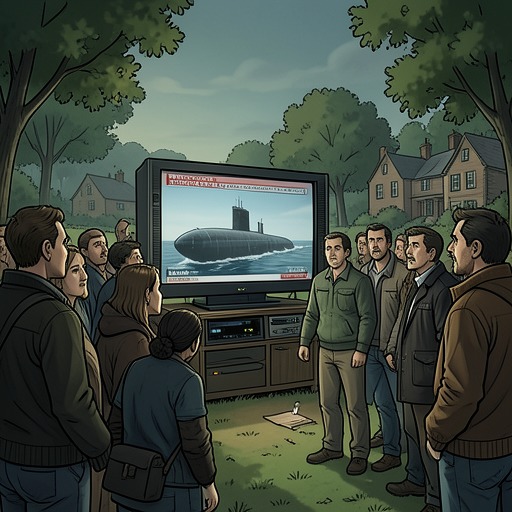
On Wednesday, 28 October, the school is buzzing with news passed along through an informal chain: a teacher listens to the radio during recess, tells a class, and by lunchtime the story has spread. The children conclude that the Russians are there, reacting to the Soviet submarine that has run aground outside Karlskrona. An international crisis arrives at school not through direct experience but through radio, retelling, and speculation.
That alarm follows a week dominated by the Vällingby murderer. Children claim to have seen him or even been attacked by him, and they mistake sketchy-looking passersby for the killer. When an older man in ragged clothes cuts across the school grounds, they flee screaming; some of the tougher boys take hockey sticks and prepare to knock him down. They release him only after someone identifies him as a local alcoholic. The episode shows how fear has already altered the children’s reading of familiar surroundings: the school grounds become a place where an ordinary passerby can briefly seem like a threat.
Oskar, Johan, and the Bomb
During lunch, Oskar talks the submarine over with Johan. Their exchange moves from whether the Russians possess a nuclear bomb to whether one could be carried aboard a submarine. Johan says that missiles can be fired from wherever they are placed, and Oskar looks up at the sky as he considers the possibility that a submarine could carry them too.
Oskar’s final thought fixes the scale of the danger in a stark contrast: people might die while the houses remained standing. The school conversation gives the children’s fear a concrete image—not simply destruction, but survival amid the recognizable structures of home. Nuclear threat enters their thinking through a question-and-answer exchange between pupils, making the school a point where global anxieties are translated into a child’s picture of what could happen to people and their neighborhood.
The Neighborhood Beyond the School
The school’s rumors belong to a wider pattern of local unease. In the Chinese restaurant in Blackeberg, Larry asks about the nearest nuclear shelter and imagines a full-scale invasion; Morgan replies that his shelter contains gas masks, canned food, and even a Ping-Pong table. The contrast between that practical inventory and the pupils’ speculation at school shows how the same submarine story circulates in different registers: as imagined catastrophe among children and as a question of preparedness among adults.
The school’s significance lies in this overlap of ordinary routine and extraordinary fear. It remains part of Oskar’s daily route, yet within its grounds familiar people can be mistaken for a murderer, and at lunchtime a distant submarine becomes a possible carrier of weapons capable of killing people while leaving their houses intact.